
Business
International Trade vs International Business: Key Differences (2026)


Know the differences between international trade vs international business, including their characteristics, advantages, examples, and career prospects for the year 2026.
What Is International Trade?
International business involves the exchange of commodities and capital between nations. This is the movement of imports and exports, where a nation will sell whatever it is producing effectively and buy whatever it is buying for cheaper or doesn’t produce at all.
The main operations involved in international business happen at the macroeconomic level, such as:
- Trading of commodities and services between nations
- Agreements on trading and tariffs between nations
- Balance of trade and balance of payment considerations
- Currency exchanges and foreign exchanges
- Policies, quotas, and regulations on trading done by national or international organizations (WTO)
Example of International Trade
When Pakistan exports textiles to the United States, or when Saudi Arabia exports crude oil to Japan, this is international business. International business is a business activity conducted between nations, recorded in national records of commerce, and significantly influenced by policies and treaties.
Features of International Trade
International business deals with the buying and selling of goods and services across countries through imports and exports of goods and services. International business is based on international logistics, foreign currency dealings, customs laws, trade deals, and international demand, thus making countries specialize in the production process.
What Is International Business?
International business, however, covers a far wider area of activities. International Business refers to all business transactions carried out through business deals, investments, partnerships, franchising, and business operations that a company conducts across different national borders to make profits.
International Business occurs at the microeconomic level or the firm level. These include:
- Foreign Direct Investment (FDI): Setting up of factories, offices, and branches overseas
- Mergers and Acquisitions Overseas
- Licensing and Franchising to Foreign Firms
- International Human Resource Management and Cross-Cultural Leadership
- International Marketing Strategy, Logistics, and Operations Management
- Just one element of international business is trade itself.
Example of International Business
If Starbucks sets up franchises in Dubai, or if a Pakistan-based software company establishes a distribution center in Germany, then it is an example of international business. International business entails much more than mere trading activities because it covers all aspects from the legal structure to market entry and beyond.
Features of International Business
International business is defined as the total set of business transactions conducted in international settings. These include foreign trade, foreign investment, global marketing, manufacturing, licensing, and logistics. This is because international business involves adjustment to other legal, cultural, financial, and business environments.
International Trade vs International Business: Key Differences
| Aspect | International Trade | International Business |
| Definition | Exchange of goods and services between countries | All cross-border commercial activities of a firm |
| Scope | Narrower — focused on import/export transactions | Broader — includes trade, investment, operations, HR, marketing |
| Level of analysis | Macroeconomic (nations, economies) | Microeconomic (companies, firms) |
| Main actors | Governments, exporters, importers | Multinational corporations, small businesses, and entrepreneurs |
| Primary goal | Maximize national economic benefit through trade balance | Maximize company profit and global market share |
| Key activities | Buying/selling across borders, tariffs, and trade agreements | FDI, joint ventures, licensing, franchising, global HR, supply chains |
| Regulatory focus | Trade policy, customs duties, WTO rules | Corporate law, foreign investment regulations, and labor law abroad |
| Risk factors | Currency fluctuation, trade barriers, geopolitical tension | All trade risks, plus cultural, operational, and management risks |
| Measured by | Trade volume, balance of trade, and GDP contribution | Revenue, market share, and ROI on foreign investment |
How They Overlap
International trade forms a part of international business. The moment an organization is involved in exporting or importing commodities, it is indulging in international trade; however, there can be other activities involving international business without any trading at all. These include
- Establishing a wholly-owned foreign subsidiary
- Forming a joint venture with a local partner
- Licensing out the technology or brand name to a foreign business
- Managing international employees
Key Difference Between International Trade and International Business
The most prominent difference is that of scope. International trade involves the transactions of goods and services across international borders only.
International business includes all international business activities such as:
- Production
- Investment
- Research
- Marketing
- Distribution
- Customer support
- Global operations
All international trade activities fall under international business; however, not all international business activities involve trade.
Advantages of International Trade
International business opens up new markets, promotes economic growth, generates jobs, promotes innovation, enhances product quality through competition, and allows consumers access to greater diversity in products and services, along with earning much-needed foreign exchange for countries through exports.
Advantages of International Business
There are several benefits of doing business in an international environment for companies, such as going global, earning more money, decreasing business risks, recruiting skilled people at affordable costs, building brand image, transferring technology, and establishing a strong supply chain around the world.
Why Pursue a Degree in International Business or International Trade
1. Competitive Edge
The international business/trade degree helps graduates achieve a competitive edge through the development of global knowledge, cross-cultural competency, and strategic thinking abilities that are highly sought after in the international business environment by employers.
2. Skills and Perspective Required by Employers
Practical skills learned include those of global marketing, global finance, international laws, communication, logistics, and problem-solving, equipping graduates to work in an international team and with international clients.
3. Career Development
The degree provides opportunities in multinational firms, government organizations, logistics, banking, consulting, and export/import companies, facilitating career development and leadership in international organizations.
4. Degree Benefits
The graduates are entitled to increased career choices, better salary prospects, international connections, practical business experience, and versatility in working in different sectors all over the world.
5. Career Aspirations Alignment
Aspiring entrepreneurs, international managers, trade analysts, and consultants will find this degree program relevant to their career plans in the developing world economy.
FAQs
Is international trade part of international business?
Yes, international business includes international trade among other elements of business on an international level. This may include international investments, international operations, international management, etc.
Which is riskier, international trade or international business?
The reason for the greater risk in international business is that international business requires long-term investment and cultural adaptation in addition to the inherent risks of international trade, including currency exchange and tariffs.
Can a small business engage in international business without trading physical goods?
Yes. Small businesses can be engaged in international business by offering their products and services virtually, licensing their products/services, forming virtual teams, or even working on e-commerce sites without having to import or export any physical products.
What careers relate to international trade vs international business?
Career opportunities in international trade include customs procedures, trade policy analysis, and export/import management. Career opportunities in international business include international marketing, international human resources management, market entry into foreign markets, and multinational management.
Conclusion
Though international trade and international business share a close relationship, there exist differences between the two with respect to their nature and objectives. International trade is about transactions conducted across borders, whereas international business involves a much broader spectrum, including transactions, investments, and management, among other aspects. The knowledge of this will enable companies to expand appropriately.
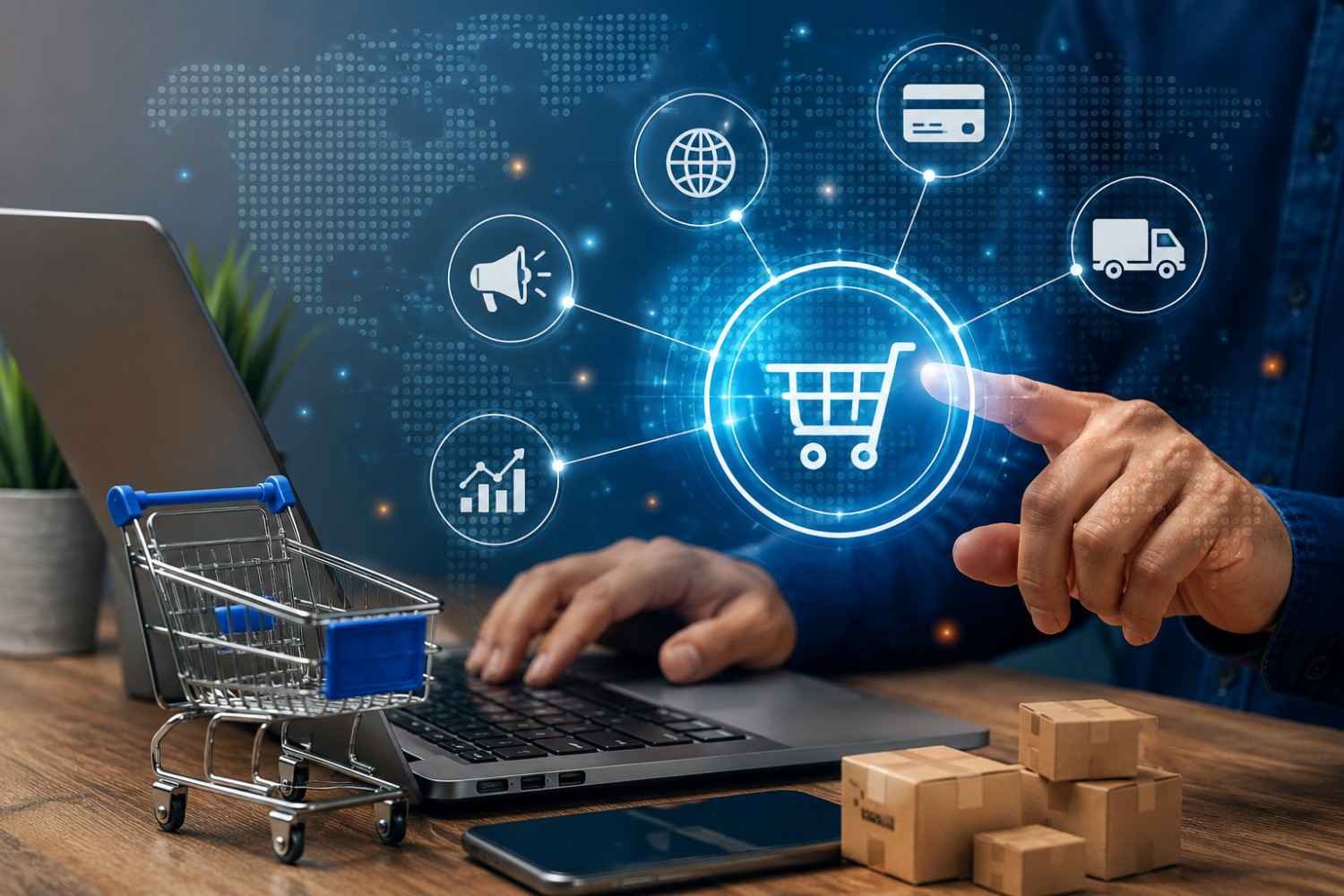
Discover the concept of e-business, types, benefits, demerits, challenges, future trends, and the operations of digital business in 2026.
What Is E Business?
E-business (electronic business) is the application of the Internet and digitization technology in conducting business. While conventional businesses conduct their activities in the real environment using paper-based and physical systems, e-business is a virtual entity run through sites, mobile applications, cloud-based software, payment mechanisms, and digital communication.
In modern times, e-business is considered to be one of the quickest-growing models in the business world. Whether a company is a new start-up or a multinational firm, the use of technology is taking place to communicate with its customers, reduce costs, increase efficiency, and make more profits.
As you engage in shopping for goods, booking hotels, attending virtual classes, or engaging in online banking, you are doing business with an e-business.
Types of E-Business
Business-to-Business (B2B)
B2B is an approach to the marketing of a product or a service where the product or the service is purchased by another company, like manufacturers, wholesalers, distributors, software suppliers, corporate services firms, etc.
Business-to-Consumer (B2C)
The B2C stands for Business to Consumer. It is used to describe any business selling products or services to consumers directly through online media like websites and apps.
Consumer-to-Consumer (C2C)
Consumer-to-Consumer is the term used to refer to a process whereby consumers are enabled to conduct transactions of goods and services among themselves without involving any intermediaries through online means.
Consumer-to-Business (C2B)
The consumer-to-business business model involves the ability for people to provide products, skills, or professional services to companies or organizations in areas such as freelancing or creating content.
How Does an E-Business Work?
E-business is described as a form of business that uses digital technology to link customers, suppliers, payments, and logistics. Customers search and purchase products or services, pay for them, and get deliveries. E-businesses apply automation technology, inventory control technology, customer support technology, and marketing technology to become more efficient.
What Are the Advantages of e-business?
1. Global Reach
E-business allows companies to be able to provide services to customers located in various cities, countries, and continents via the internet. No more geographical constraints are in effect as businesses can now reach out to a larger customer base, open up more sales avenues, and establish a robust global brand presence.
2. Cost Efficiency
E-Business cuts down on the operating costs of running a business without the need to have any physical locations, printing, or manual work. Automating tasks, reducing administrative needs, and freeing up more resources for innovation, marketing, and customer satisfaction are all benefits for businesses.
3. 24/7 Availability
E-business websites have the advantage of being accessible 24/7 as opposed to conventional shops that have defined working hours. As such, consumers can browse, purchase, pay, and seek assistance anytime. E-commerce proves to be valuable, helpful, and, as such, increases sales capacity and customer satisfaction.
4. Personalized Customer Experience
With the aid of customer data and AI, the e-businesses can customize their products, promotions, and even content. Not only does personalized experience assist in developing customer relationships and loyalty, but it also makes sure that there will be repeat customers in the future.
5. Improved Customer Service
The channels of digital communication, such as live chats, emails, chatbots, and self-service portals, assist companies in providing efficient customer service. The prompt response can help in solving issues efficiently and creating customer relationships.
6. Streamlined Operations
Various business operations in e-business include inventory control, ordering, billing, and delivery systems. The application of automation decreases human error, saves time, increases efficiency, and also allows employees to think strategically about the development of the company.
7. Data-Driven Decision-Making
E-business solutions enable the companies to gather customer and sales information that will assist the companies in gathering purchasing behavior of the customers, performance measurement, identifying trends in the market, and taking decision accordingly. Data analytics assists in formulating marketing strategies.
8. Cost-Effective Marketing
Digital marketing techniques like search engine optimisation, social media marketing, e-mail marketing, and web marketing enable businesses to access specific audiences and to do so at a reduced cost as compared to traditional marketing. These strategies will help them see more customers, provide them with quality leads, and lead to more conversions.
9. Scalability
E-Business gives businesses the capacity to serve more people and offer more goods and services without having to invest much in terms of infrastructure. Increased demands, new markets, and the ability to boost sales volumes without sacrificing efficiency and flexibility.
10. Enhanced Security
Modern-day e-business uses things like encryption, payment systems, various ways of authentication, as well as new software to protect the vital information of customers and organizations. Enhanced security will help improve customer trust and reduce the risks of fraud and theft.
Disadvantages of E-Business
1. Increased Competition and Market Saturation
By e-business, anyone can get into the virtual marketplace and create competition. Companies need to continuously adjust themselves regarding pricing, quality, customer service, and marketing strategies to get customers and keep them.
2. High Initial Setup and Marketing Costs
It takes a significant amount of investment in website development, secure payment systems, branding, website optimization, digital marketing advertisements, and continuous efforts to build a successful e-business and create a regular stream of income and profits.
3. Complex Return Logistics
The product return, exchange, and refund processes, along with the reverse logistics processes, can be complicated. Poor handling of the returns policy will increase costs, disappoint the customer, and affect the inventory management process of the business.
4. Security and Privacy Concerns
There are various risks in e-businesses, including cyberattacks, data breaches, payment fraud, and identity theft. The critical customer and business information needs to be protected by strong cybersecurity measures.
5. Tech Dependency
Internet connectivity, computer software, and technology play a significant part in the development of e-business operations. Technical difficulties with servers and software can influence the sales and customer service process of a business.
6. No Physical Experience
The virtual shoppers cannot see, touch, or taste the products before making the purchase, which might affect their confidence in the products, thus leading to either a return or an exchange of the products.
Challenges of E-Business
The difficulties faced by e-commerce firms include cybersecurity threats, competition, costs associated with the technology, lack of consumer trust, transportation challenges, data protection concerns, and quickly developing technology innovations.
Future of E-Business in 2026 and Beyond
Artificial intelligence, automation, voice commerce, blockchain, personalized shopping, cloud computing, and cybersecurity are the technologies that will affect the future of e-commerce. The organizations that take on the use of digital technology and create an experience for their customers will reap from their investment.
FAQs
Is e-business different from e-commerce?
Yes. E-commerce is about conducting transactions of buying and selling products and services through the internet, whereas e-business includes all those business operations that are conducted digitally and may include marketing, logistics, financials, and customer service, amongst others.
Why is e-business important today?
The importance of e-business is the fact that it enhances efficiency, creates a better experience for customers, enables people to work remotely, helps to expand into the global market, and caters to the changing needs of customers.
How does e-business help small businesses?
E-business benefits small firms by lowering costs, increasing market penetration, making them more competitive with larger firms, improving the automation of business processes, and expanding without large capital investments in physical infrastructure.
Conclusion
E-business has changed the way business is conducted in today’s world, allowing companies to use digital technologies to make sure they work efficiently. There are so many growth opportunities associated with e-business, ranging from the ability to access global markets to automation and customer personalization. Innovations, cybersecurity, and customer centric approach will be key drivers for success in the digital environment.
Discover the best business hubs in India, the best startup cities, industries, investments, and the best business destinations in India in 2026.
Business Hub in India
Economically, India has been one of the fastest-growing economies, drawing many business entities and entrepreneurs, manufacturers, and foreign investors. A few cities within India play an important role in contributing to the economy of India in the technological, financial, manufacturing, export, retail, logistics, healthcare, and innovative sectors.
India continues to attract both domestic and international businesses because of its large consumer base, skilled workforce, infrastructure development, digital revolution, and Make in India, Digital India, Startup India, and PM Gati Shakti initiatives by the government.
What Defines a Business Hub?
A business hub is a city or area that has a good mix of infrastructure, a skilled workforce, good access to markets, an appropriate regulatory environment, and connectivity that allows businesses to establish, expand, and thrive. The main characteristics include:
- Strong physical and ICT infrastructure (airports, highways, ports, internet connection)
- Skilled and semi-skilled labor force
- Lack of access to capital, banking, and financial services
- Corporate offices, industrial parks, and special economic zones (SEZs) are present.
- Ease of doing business, such as conducive state policies and single window clearances;
- Proximity to suppliers, customers, and logistics networks
India’s business hubs can be financial centers, technology and innovation hubs, or manufacturing or trading economic zones.
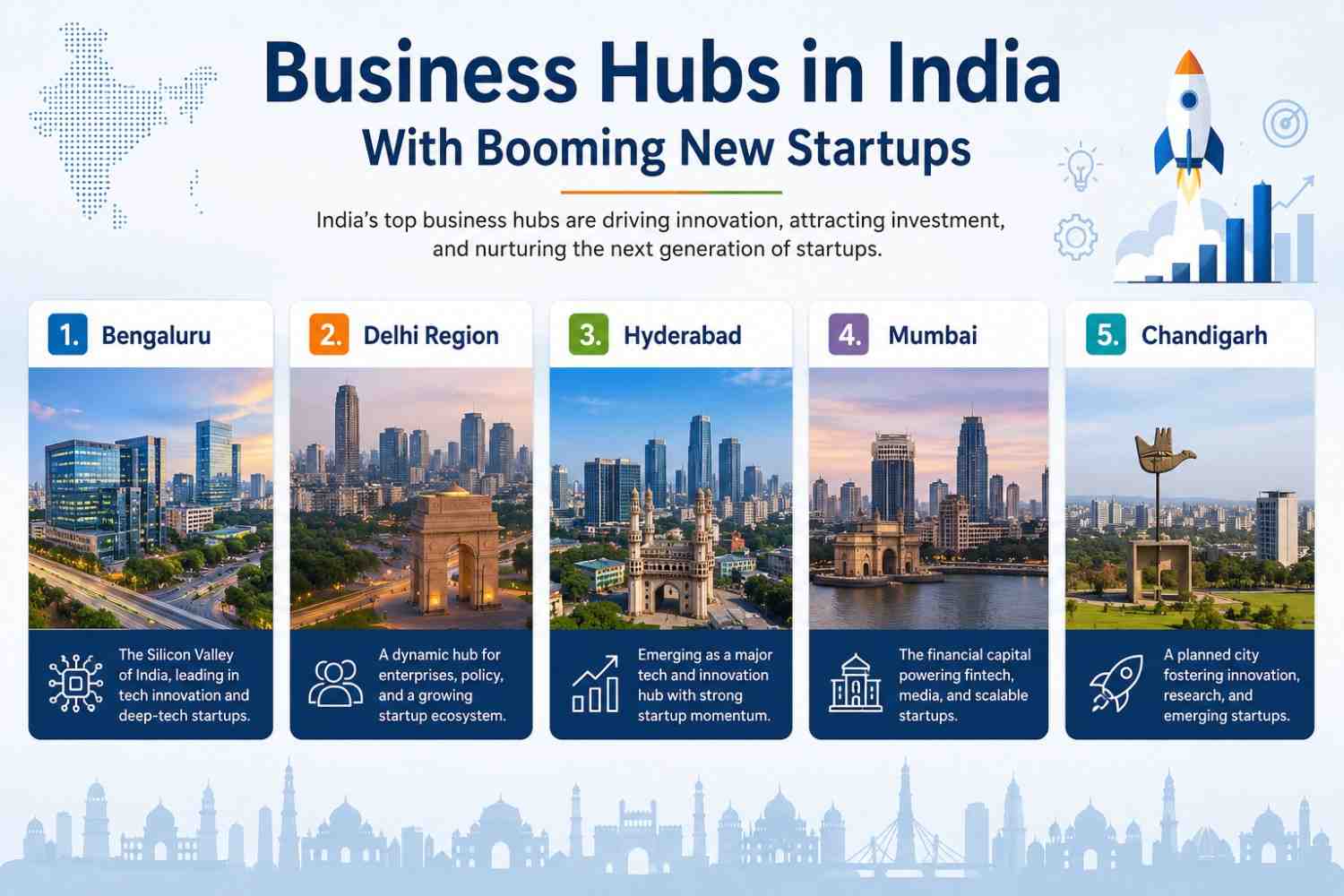
Top 10 Business Hubs in India With Booming New Startups
1. Bengaluru
Bengaluru is a startup center for India due to its existing technology ecosystem, talent, presence of international IT companies, venture capitalists, and innovation labs. It offers great opportunities for startups to develop rapidly within AI, SaaS, fintech, and biotech industries.
2. Delhi Region
Gurugram and Noida are important business centers where there exist many startups from such areas as fintech, e-commerce, logistics, education technologies, and consulting. The infrastructure is high-quality, the offices are corporate, and the network of investors is also very good, which attracts entrepreneurs.
3. Hyderabad
Hyderabad has become an emerging startup center today that specializes in the fields of technology, biotechnology, pharmaceuticals, and artificial intelligence. Innovators and investors continue to be attracted by the city due to its low cost of doing business, advanced infrastructure, governmental programs, and talent pool of professionals.
4. Mumbai
With a wide array of opportunities in finance, fintech, media, entertainment, real estate, and digital commerce, Mumbai is India’s financial capital for startups. Investors’ involvement, business networking, and access to capital allow startups to scale their business nationally.
5. Chandigarh
North Indian cities such as Chandigarh have emerged as a promising startup destination in India, especially in sectors like IT services, healthcare, education, and digitization. The right infrastructure, qualified professionals, and government assistance have helped entrepreneurs establish startups.
6. Kolkata
Kolkata has seen a continuous and sustained growth in terms of startups in the technology, logistics, manufacturing, healthcare, and creative industry sectors. New businesses have the advantage of low operating costs, growing IT parks, an excellent education system, and strategic eastern connectivity.
7. Chennai
The city has an important business environment and has an established presence in the automobile, information technology, healthcare, electronics, and software as a service sectors. The conditions to grow and innovate businesses are favorable due to good infrastructure and industrial networks.
8. Ahmedabad
The Ahmedabad entrepreneurial community has been strengthened by different booming industries, including manufacturing, textiles, pharmaceuticals, chemicals, and the fintech industry. The low cost of operations, along with industrial development and good business policies, make it an attractive destination for young enterprises.
9. Indore
Indore is one of the fastest-growing startup cities in India, known for its clean infrastructure, business-friendly environment, education, and growth of the technology sector. Entrepreneurs take the initiative to create successful businesses due to government support and low business expenses.
10. Lucknow
Lucknow is quickly becoming an emerging business hub with growing investments in the IT, health care, retail, manufacturing, and digital services sectors. There are also good opportunities for new businesses, due to better infrastructure, startup programs, and increasing demand by consumers.
Why India Is Becoming a Global Business Hub
India is emerging as a business and investment hub in the world for several reasons:
- Large Domestic Market: India has a large consumer base of more than one billion, which makes it an appealing market for businesses.
- Young and Skilled Workforce: A significant population of working age and increasingly skilled and trained is backing a wide range of industries.
- Government Programs: The ease of conducting businesses as well as the inflow of foreign direct investment has been improved by the different programs that include Make in India, Startup India, Digital India, and the PLI scheme.
- Digital Infrastructure Growth: Easy Internet access and digital payment have allowed businesses to be quickly digitized in a variety of industries.
- Special Economic Zones (SEZs) and Industrial Corridors: Specifically, special economic zones for trade and investment that provide facilities in terms of taxation and other incentives continue to be preferred for manufacturing and exports.
- Global Capability Centres (GCCs): The participation of India in global value chains is increasing, and cities in India have become increasingly attractive locations for multinational companies to locate their GCCs.
Choosing the Right Business Hub in India
The decision of where to operate in India can be influenced by factors such as industry, target market, talent availability, and cost factors. For example:
- The city of Bengaluru or Hyderabad is preferred by technology and startup companies.
- The financial services companies tend to move towards Mumbai or GIFT City.
- Pune, Chennai, or Ahmedabad could be the better options for manufacturing companies.
- Delhi NCR is a preferred location for companies wanting to be near the government and policymakers.
Conclusion
There is a plethora of options for business in India, depending upon the technology, finance, manufacturing, logistics, healthcare, and innovations. Bengaluru’s vibrant start-up scene and Mumbai’s strong financial sector, alongside Chennai’s excellence in industries, make them different from one another. Selecting a suitable business hub according to the industry requirements will help sustain the growth of any business.

Discover how to launch your own waffle business with advice on how to plan, market, license, price, and deliver your product for success.
Waffle Business is a type of Food Business that mainly involves the manufacturing and sale of waffles in different styles, such as Belgian waffles, bubble waffles, classic waffles, gourmet waffles, and so forth. There are numerous options for running the business, such as running it through a café, food truck, kiosk, or at home, and so on. Income may come from toppings, drinks, and dessert packages.
What Is an Online Waffle Business?
An online waffle business is a food business that sells waffles online, rather than from a retail location alone. They order on your site, social media feeds, food delivery apps, or online marketplaces, and then you prepare and deliver these products.
If you are using any business model, you can sell:
- Fresh-made waffles
- Belgian waffles
- Bubble waffles
- Mini waffles
- Waffle sandwiches
- Frozen waffles
- DIY waffle kits
- Waffle mixes
- Toppings and sauces
- Specialty desserts
A lot of waffle entrepreneurs start up out of a home kitchen that they have a licence for, before moving into a commercial kitchen or a café.
Can I Start an Online Waffle Business?
Certainly, an individual can develop a successful online waffles business with proper planning and marketing skills. One should first develop a special menu, get licenses if necessary, buy good-quality equipment, and provide online ordering and delivery services. It is advisable to market one’s brand using social networking sites, local SEO, and customer reviews to gain loyal customers.
Why Start an Online Waffle Business?
Customers enjoy getting a treat that is readily accessible, affordable, and delivered at their doorsteps, which is the reason why the dessert business is continuously growing. The waffles are very customizable, appealing to all ages.
Benefits include:
- Low cost compared to opening an actual café
- Flexible working hours
- Working from home kitchen (if permitted)
- Larger customer base due to delivery apps
- Easier menu expansion with desserts and beverages
- Social media-friendly
By appropriate planning, an online waffles company may be able to expand into a food truck, café, or even franchising.
Types of Waffle Businesses
1. Food Truck or Mobile Waffle Stand
Mobile waffle trucks and stands are flexible ways that can be adopted in providing fresh waffles to customers at festivals, markets, parks, and even on busy streets. It is less expensive than a traditional café to start up and can go to other customers.
2. Café or Brick-and-Mortar Waffle Shop
A café or brick-and-mortar waffle shop provides customers with a comfortable dining experience. In addition to waffles, offer coffee, beverages, desserts, and snacks – boost sales and repeat business.
3. Waffle Kiosk in Malls or Events
A waffle kiosk is located in areas with high traffic, including shopping malls, airports, exhibitions, or events. Besides the small area helping in reducing the rent, it presents the best opportunity for making fast sales of the desserts.
4. Online Waffle Business (Delivery & Catering)
An online waffle business is an e-commerce company that sells, delivers, and provides takeout waffles via social media, websites, and food delivery apps. It’s a cheaper option and can help you target your customers without having to open a brick-and-mortar store.
How to Start a Profitable Waffle Business in 2026
Step 1: Choose Your Business Model
Adopt an appropriate business model depending on the budget and goals available, including food trucks, café, kiosks, franchises, and even an online waffle delivery business.
Step 2: Conduct Thorough Market Research
Conduct further research about the competitor environment, consumer behavior, costs, demand levels, and food trends, allowing you to learn of possible business ideas, giving a competitive edge to your business.
Step 3: Develop Your Financial Plan
Develop an extensive financial plan that covers start-up costs, cost of equipment, cost of operation, estimated revenue, cost structures, and sources of funding to ensure future success.
Step 4: Secure the Perfect Location
Choose a location that is crowded and visible to your prospective market segment, easy for your business, and sufficient in size to conduct your day-to-day business efficiently.
Step 5: Set Up Operations and Infrastructure
Purchase good waffle machines, organize your kitchen, build supplier relationships, establish food safety practices, and organize the kitchen operation process.
Step 6: Menu Development and Pricing Strategy
Give customers a pretty extensive menu, something with the top toppings, great drinks, and dessert picks for their waffles, and well, this will be available at a competitive price range as well.
Step 7: Hire and Train Your Team
We should also make sure we have professional staff, trained in food prep, cleanliness, customer service, and the day-to-day operational processes.
Step 8: Optimize Operations Post-Launch
We also collect feedback from consumers, tweak recipes when needed, cut down on food wastage, streamline tasks, and then use sales data analysis to boost efficiency, improve customer satisfaction, and support overall organizational performance.
Step 9: Plan for Growth
Then, grow the menu or offer catering, open new outlets, or franchise the product line, while staying alert to marketing moves and innovation.
How Much Money Can You Make Selling Waffles Online?
The income depends on the model, pricing, and marketing. These are realistic ranges:
| Business Model | Monthly Revenue Potential |
| Local fresh waffle delivery | $500–$5,000 |
| Waffle mix kits (Etsy/Shopify) | $1,000–$15,000 |
| Subscription box | $2,000–$20,000+ |
| Waffle catering (events) | $1,500–$10,000 |
| Online waffle courses | $500–$10,000 |
Most food business owners who do business from their home start on the side, making $1,000 to $3,000 per month, and then switch to full-time income in 12-24 months.
Pros and Cons of Starting an Online Waffle Business
Pros
- Lower barriers to entry than physical restaurants
- Flexibility in scheduling and the possibility of working from home
- Waffles are universally popular
- Very shareable on social media (organic reach)
- Various income streams can be tapped (products, classes, and catering services)
- Increasing interest in specialty and artisan foods
Cons
- Complicated food laws that differ by location
- Perishable goods necessitate proper logistics
- Compelling competition – hence, differentiation is crucial
- Requires access to a commercial kitchen to scale
- Seasonal variability in demand is possible
Conclusion
Starting a waffle company online is one of the cheapest and best ways of entering the food business industry. Using good recipes, good branding, good marketing, and good customer service, a good business can be established from the comfort of one’s house or using commercial kitchens.
-

 BLOG2 years ago
Unlocking Opportunities: Top Small Business Ideas in Hyderabad
-

 Business2 years ago
Hеartfеlt Bеst Wishеs for Nеw Businеssеs: Encouragеmеnt & Succеss Tips
-

 BLOG2 years ago
Top Automotivе Businеss Idеas: Explorin’ Profitablе Vеnturеs in thе Auto Industry
-

 BLOG11 months ago
What is Traceloans.com Student Loans?
-

 BLOG2 years ago
Medicine Wholesale Business: An In-Depth Overview
-
BLOG2 years ago
Business Ideas in Tamilnadu: Profitable Options for Entrepreneurs
-

 BLOG2 years ago
Part Time Business Ideas in Tamil You Can Start from Home
-
 BLOG2 years ago
New Business Ideas in India: Exploring Prospects in a Vibrant Economy